
Products

High-field MRI Coils
     Head RF
     Knee RF
     Small-Animal RF Platform
     Small- Animal RF Modules
     Vertical Bore Imaging
     Surface Coils
     MRI 3 Axis Gradient Coils
     Head Gradients R&D
Solids NMR Probes
     OptiMAS Low E
     XC MAS Probes Low E
     HT MAS
    SAS Switched Angle
     Non-spinning NMR Probes
     Cryo-Coil MAS
Liquids NMR Probes
Diffusion/PFG Probes
Supplies and Accessories
     Probe Controllers
     Rotors and Caps
     Susceptibility plugs


  Doty RF Litz Coils

What is A Litz coil?

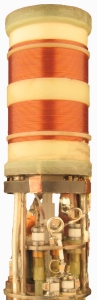
The Litz (woven) coil utilizes etched foil patterns with insulated crossovers to obtain rf flux transparency and improved S/N.  Special symmetries permit an ideal current distribution that is compatible with high-frequency operation and is independent (to first order) of tuning, balancing, and matching adjustments. Homogeneity is excellent and tuning is simple.

How does a Linear Litz coil compare to a Linear Birdcage?

•  Much Easier Tuning.

    Easily tuned and matched to a wide range of samples.  

    Compatible with double-resonance multinuclear tuning,                                

    with little loss in efficiency or homogeneity.

•  B1 homogeneity is 10-40% better.

•  SNR is at least 10% higher - up to 30% higher.

    Up to 50% higher S/N in small 1H coils (below 30 mm), and

    up to twice the S/N for double-resonance.

•  Enormous B0 homogeneity advantage in small coils.

    Linewidth generally less than 0 .02 ppm, which may be an order of

    magnitude better than what is often seen in small birdcages.

•  Substantial cost advantage.

When is a linear Litz Coil recommended over a CP Litzcage?

The Litz coil is usually preferred for double-tuned coils. Also, small Litz coils at lower frequencies have equal or better homogeneity and S/N than quadrature coils. The ease of tuning and lower cost often make them the best choice for small coils.

When is a CP Litzcage recommended over a linear Litz Coil?

Usually for single resonance where the frequency-diameter product is greater than 9 MHz-m (e.g. a 30 mm coil at 300 MHz), but other factors include available space and budget.

Preprint available RF Coil Technology for Small-Animal MRI.
Download a preprint of “RF Coil Technology for Small-Animal MRI”, by F. David Doty, George Entzminger, Jatin Kulkarni, Kranti Pamarthy and John P. Staab, published in [NMR Biomed. 2007; 20: 304-325, published online in Wiley Interscience, at www.interscience.wiley.com, DOI: 10.1002/nbm.1149].

Please contact sales with questions or quote requests.